Organization Profile
Organization Profile is the first page in Configure Settings. Use it to set your organization's identity: name, domain, logo, timezone and profile. This page also explains how the Settings area is laid out, so you can find the other settings pages from here.
Opening Configure Settings
- In the left sidebar, click Configure Settings (the gear near the bottom).
- Settings opens on Organization → Profile (its page heading reads Organization Profile).
Finding your way around Settings
The left-hand navigation groups settings under collapsible headers. Opening one group closes the others, and the group that contains the page you are on expands by itself.
| Group | Pages |
|---|---|
| Organization | Profile, Users, Teams, Personas (once personas are enabled for your organization) |
| Data Model | Item Types, Priority Levels, Item Statuses, Subtask Statuses, Tags, Custom Fields, Effort Point Estimation and Time Estimation, Workspace Tab Order and Sidebar Field Order |
| Other | Cadences, Import History |
| Service Desk | Service Desk, Request Forms, Single sign-on, SLA Policies, Schedules — see Service Desk |
| Inbound addresses, Sending domains | |
| Knowledge Base | Stages — see Spec stages |
| Integrations | Credentials, GitHub, Slack, Microsoft Teams, Database Access, Identity Providers, Webhooks, Jira, Formwork and Azure DevOps where available |
| AI Assistants | Settings, Connect AI, Usage, Budgets, Prices — see AI Assistant settings and permissions |
| Subscription | Your Plan, Billing Details, Payment Method, Billing History — see Subscription & Billing |
| Admin | Global Automations, Formatting Rules, Time Tracking, Permissions, Training Sandboxes, Authentication Log |
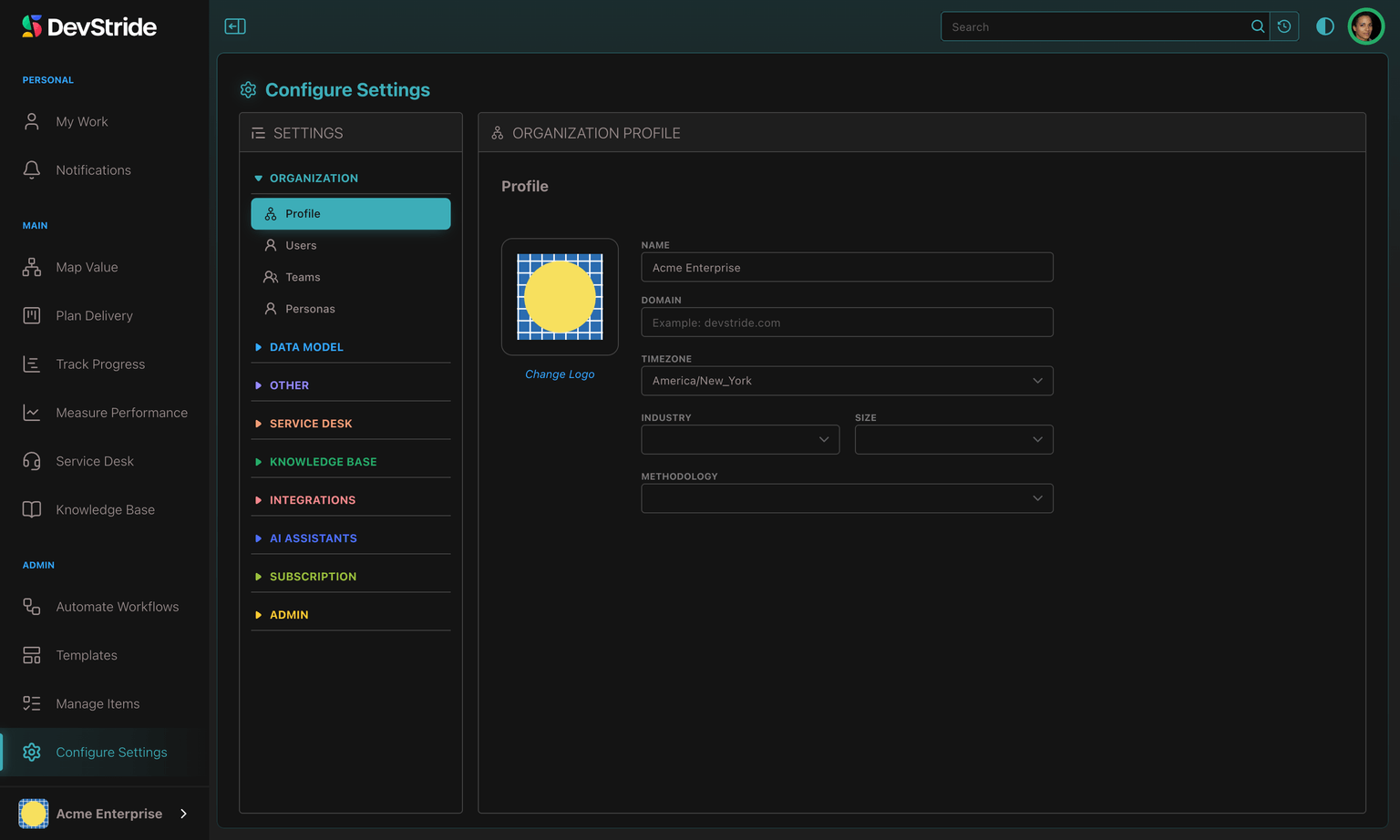
Editing your organization's profile
Everything on the Profile panel saves as you go; there is no Save button. Text fields save when you click away, and the logo and dropdowns save the moment you change them. A green Updated mark confirms a stored change.
| Field | What to enter |
|---|---|
| Logo | Click the logo placeholder and choose an image. It saves as soon as you pick it. Once a logo is set, click the logo itself (or Change Logo under it) to replace it. |
| Name | Your organization's display name. |
| Domain | Your web domain, for example devstride.com. Anything that is not a valid domain shows Invalid and is not saved. |
| Timezone | The timezone your organization operates in. Type to search the list. Monthly time-tracking periods and dates shown in Settings use it. |
| Industry | One or more industries. |
| Size | Employee count: 1-9, 10-49, 50-99, 100-499 or 500+. |
| Methodology | One or more of Scrum, Kanban, Agile, Scaled Agile, Continuous, Extreme Programming, Waterfall, Lean, SAFe, Other. |
Managing personas
Personas (Engineer, QA Analyst, and so on) describe the kind of work a person can take; they are separate from access roles and grant no permissions. The catalog lives at Configure Settings → Organization → Personas and personas are given to people from Users. The full walkthrough is on Personas; assigning them to members is covered in Giving a member personas.
Requiring multi-factor authentication
There is no switch on this page to require MFA for every member. The organization setting exists (requireMultiFactorAuth on the organization record) but is set through the API or by DevStride support rather than in Settings. When it is on, members cannot sign in with Google, Microsoft or Enterprise SSO, because those sign-ins bypass DevStride's MFA challenge — see Users, Roles & MFA. Individual members turn on their own MFA from My Account → User Profile.
Where to go next
- Invite people and set their roles on Users, then group them on Teams.
- Shape your work model under Data Model, starting with Item Types.
- Connect tools under Integrations and review your plan under Subscription.
Setting Up Basic Automations
Build Automations that watch for a trigger, check optional conditions, and run one or more actions: the full catalogue of triggers, conditions, and actions, plus worked recipes.
Users, Roles & MFA
Invite members, review who can do what, edit a member's role, personas and labels, reinstate or archive people, reset a locked-out member's password or MFA, and set up your own MFA.